J anuary cold lingers with $1 million power cost adjustment
by General Manager Steve Stroshane
As we look forward to spring flowers and warming temps, I'd like to explain how a cold snap back in January is impacting the cost of power today.
In February, Polk-Burnett received news of a power cost adjustment (PCA) of just over $1 million on our wholesale power bill from Dairyland Power Cooperative. The PCA is an additional $1 million, above our cost of power. Normal PCAs are passed through to member electric bills, either as a charge or credit, per board policy. However, this wasn't a normal PCA. Read on to see why energy prices skyrocketed and how we worked to lower the impact for our members.
Winter Storm Fern unleashes cold and snow
It's not unusual for northern Wisconsin to be cold in January. We're prepared to handle a stretch of 20-below temps. But this last January, an Arctic blast impacted a large part of the country, from the Midwest to the South and East Coast. Do you remember pictures in the news of Washington, D.C. blanketed in snow, Nashville coated in ice and freezing temperatures all the way down to Texas and Florida? Even here at Polk-Burnett, where we are used to the cold, we set a new winter peak for energy use across our system in January 2026.
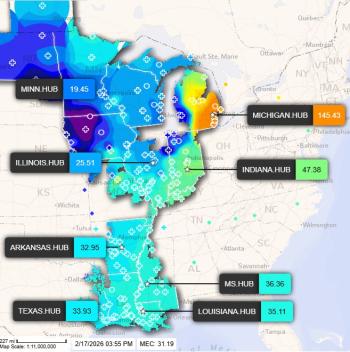
The high demand for heat and electricity stretched the grid throughout the region, and energy market prices rose sharply. The price of natural gas, used to fuel residential heating and power plants, increased 250%!
Bad timing for coal plant outage
To make matters worse, Dairyland's J.P. Madgett coal plant shut down Jan. 15 to Feb. 5 for an unplanned repair of the system that collects and removes bottom ash (tons of coal ash were stuck at the bottom of the boiler and required blasting to break free). With the 387-MW plant out of service, Dairyland had to buy more electricity than planned on the energy market, which came at a high price as temps dropped and energy demand soared across the region.
Dairyland is our wholesale power provider.
We buy power from Dairyland Power Cooperative and distribute it to you, our local members.
 Conservation and load management reduced demand
On Saturday, January 24, the Midwest Independent System Operator (our regional grid operator that serves from Manitoba to Louisiana) initiated a Max Gen event to manage the shortage of electricity and high prices, caused by high demand. Both MISO and Dairyland appealed to the public to conserve energy, and devices in our load management program were controlled across our system. We thank our members who participate in load management; this program is critical for shedding energy load when demand and prices are high.
You can view current MISO grid conditions, fuel mix and energy market prices on misoenergy.org.
Local solar helped power the grid and offset high market prices
To our advantage, the cold stretch was also bright and sunny, and our four solar arrays (SunTuria, Georgetown, Luck and Viola) helped reduce our wholesale power demand and cost by generating electricity locally. Our investment in local solar not only relieves high summer demand, but also offsets power market costs all year long. Solar energy produced locally reduced the amount of electricity we had to buy from Dairyland at a higher cost.
Lowering the financial impact of January's market-driven increase for our members
As I shared above, our power cost adjustment from Dairyland was just over $1 million for the month of January. Normally, PCAs from Dairyland are passed through to members, per board policy. But this wasn't normal. PCAs on our Dairyland power bill for all 12 months of 2025 totaled $529,000, not even close to our January PCA of $1 million.
Instead of passing the full amount to our members, we researched many options and worked within our budget to pay down and absorb $831,000, which is 76% of the January PCA from Dairyland. This lowers the power cost adjustment to 1.17¢ per kWh for members, instead of the full 4.6¢. The PCA from Dairyland was spread over two months on March (0.55¢/kWh) and April (0.62¢/kWh) electric bills. We know higher bills are never welcome, but we hope this eases the burden.
As a cooperative, we are committed to keeping electricity rates as low as possible for members, with the goal of recovering actual costs, not generating profit. You can see a refresher on electric bill charges below and we're here to help if you're looking for ways to lower your energy use, 800-421-0283, ext. 595.
 Understanding your electric bill
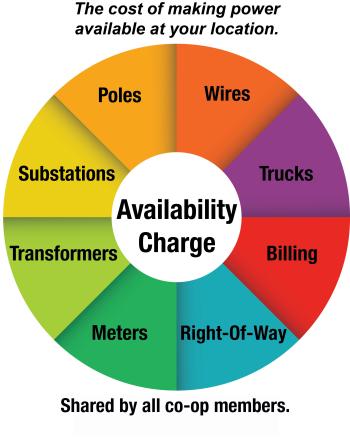
As a not-for-profit cooperative, Polk-Burnett sets rates to provide electricity at the cost of service, not to generate profit. For transparency, your electric bill is itemized into three charges:
1. Availability Charge: Covers costs to build and maintain the electric system. Whether you use electricity a little or a lot, this is the investment needed by each member to bring power to your location. This charge is higher in rural areas because costs are shared by fewer members. At Polk-Burnett, six members per mile of line share costs versus 20 to 40 customers at utilities in areas with higher population density.
2. Energy Charge: Covers the cost of electricity you use.
3. Power Cost Adjustment (PCA): Either a charge or credit that fluctuates as the cost of power goes up or down. The wholesale energy market is volatile, usually higher in summer and winter, and lower in spring and fall.